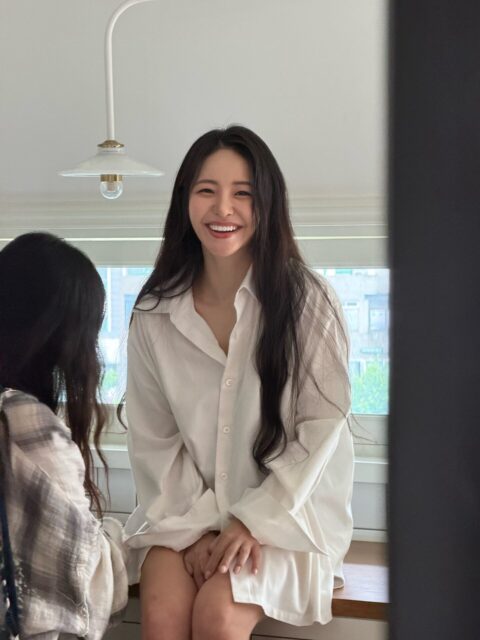

K-Drama Star Ha Young Faces Ancestral Pro-Japanese Controversy Amid New Drama Filming
Actress Ha Young continues filming SBS’s upcoming Friday-Saturday drama ‘The Long Shot Trial’ without disruption despite finding herself at the center of intense controversy after her great-grandfather’s pro-Japanese activities during Japan’s colonial rule came to light ahead of Liberation Day.
The drama has been confirmed as a remake of a popular Japanese series, raising questions within the broadcasting industry over how the controversy surrounding its leading actress’s family history could affect the production.
“The Long Shot Trial” & Ha Young’s Role Amidst The Storm
Filming for ‘The Long Shot Trial’ continues amid the escalating controversy. SBS has stated that it is “monitoring the situation closely” but for now, production seems to be on track. According to reports from the entertainment industry on August 12, Ha Young was cast as the female lead in SBS’s new Friday-Saturday drama ‘The Long Shot Trial,’ which is currently in production with the goal of premiering in February next year.
Ha Young reportedly continued filming as scheduled even on the day public criticism intensified following the confirmation of her great-grandfather Ahn Sang Ho’s pro-Japanese activities. Industry insiders believe the possibility of her leaving the drama midway through production remains low. There is still considerable time before the premiere, and it is difficult to determine whether controversy surrounding the female lead’s historical awareness will ultimately affect the drama’s success.
Regarding the matter, SBS stated, “A significant portion of the drama ‘There Is a Winning Chance’ has already been filmed,” adding, “It is difficult to provide specific details regarding the amount of footage completed or the exact production progress at this time.” The network continued, “We are fully aware of the matter and are closely monitoring how the situation develops.”
‘The Long Shot Trial’ is a comedic legal mystery that follows a former lawyer turned law office manager who uses unconventional methods to turn seemingly unwinnable cases into victories. Actor Lee Jae Hoon will star as the male lead, Kwon Baek, alongside Ha Young. In the drama, Lee Jae Hoon plays Kwon Baek, a once-successful star lawyer who lost his license after becoming embroiled in a bribery scandal. After suddenly disappearing from the public eye, he gathers a motley group of people and opens a shabby law office before making a spectacular comeback as its office manager. Using elaborate traps and theatrical schemes to uncover the truth, Kwon Baek causes a stir as an eccentric manager who is even more capable and entertaining than he was during his days as a lawyer.

Ha Young plays Yeo Shim Hee, a rookie lawyer who has little money or connections but prides herself on her diligence. Unaware that her role model Kwon Baek has fallen from grace, Yeo Shim Hee accepts his offer to join Law Office Seungsan as its senior lawyer. She is initially disappointed when she sees how far her former role model has fallen, but becomes inspired by Kwon Baek’s ability to anticipate his opponents’ next moves. Through their experiences, she grows into a capable lawyer.
The drama is based on the 2018 TV Asahi series ‘Ex-Lawyer Shoko Takanashi.’ The Japanese original starred top actress Ryoko Yonekura and followed a disbarred former lawyer who assembles a group of problematic attorneys to take on major law firms and powerful figures. The Korean adaptation retains the original’s central premise while modifying certain elements to reflect the Korean legal system. Unlike the Japanese original, which was produced as an extension of Yonekura’s hit series ‘Doctor X’ and placed a female protagonist at the forefront, the Korean version has been reworked as an independent production with Lee Je Hoon’s male character at the center.
Unveiling The Past: The Controversy Begins
The controversy surrounding Ha Young began with an episode of KBS 2TV’s variety show ‘Problem Child in House,’ which aired on August 7. During the appearance, Ha Young introduced herself as coming from a “four-generation family of doctors” and said, “My great-grandfather studied medicine in Japan, then opened a Western-style medical clinic in Hanyang and even personally treated Emperor Gojong.”

Given the severely limited opportunities for Koreans to advance socially during the late Joseon period and Japan’s colonial rule, studying abroad in Japan alone would not necessarily establish that someone was pro-Japanese. His return to Korea, opening of a medical practice in Hanyang, and treatment of Emperor Gojong could also have been viewed as contributions to the development of modern medicine on the Korean Peninsula. However, the situation changed after online communities and historical records identified the great-grandfather Ha Young had mentioned as Ahn Sang Ho, a figure from the Japanese colonial period.
Ahn Sang Ho participated in the Daijeong Friendship Association in 1916 as a council member. The organization is widely classified as a prominent pro-Japanese group. The Maeil Shinbo, a newspaper that served as a government-affiliated publication during the colonial period, also featured Ahn Sang Ho’s family as an exemplary case of “Japan-Korea assimilation,” highlighting their adoption of Japanese-style customs and lifestyle. Records also show that Ahn Sang Ho told the Maeil Shinbo in a 1918 interview that he lived a lifestyle virtually indistinguishable from that of Japanese people and had little interaction with Koreans. As these records emerged, criticism spread rapidly, with some members of the public accusing Ha Young of carelessly boasting about her family background on a national television program without fully understanding her great-grandfather’s historical record.

Agency’s Shifting Stance & Ha Young’s Apology
As the controversy intensified, Ha Young’s agency, BISTUS Entertainment, stated on August 10, “It is true that her great-grandfather was Mr. Ahn Sang Ho, but the allegations of pro-Japanese activities raised online are completely unfounded.” However, the agency’s categorical denial drew further criticism because historical records and concrete evidence, including the Daijeong Friendship Association’s membership list and Maeil Shinbo articles, had surfaced.
As criticism mounted, the agency backed away from its initial position, saying it would “review the details again and provide a sincere response after further verification.” On August 11, the agency officially reversed its previous “unfounded” claim. In a statement, it said, “After further verification, we confirmed the record showing that great-grandfather Ahn Sang Ho was listed as a council member of the Daijeong Friendship Association in 1916.” The agency added, “We sincerely apologize for causing confusion by hastily responding that the allegations were ‘unfounded’ without conducting sufficient verification.”
Historical scholars have also revisited assessments of Ahn Sang Ho’s activities. Lee Joon Sik, former director of the Independence Hall of Korea and a contributor to the compilation of the Dictionary of Pro-Japanese Collaborators, said, “The Daijeong Friendship Association was a pro-Japanese organization established during Japan’s military rule to recruit influential Koreans and promote the idea of harmony between Japan and Korea.” He added, “If Ahn Sang Ho served as a council member of the organization, it is reasonable to regard him as having engaged in pro-Japanese activities.” Historian Shim Yong Hwan, however, offered a more nuanced assessment. While stating that Ahn Sang Ho’s participation in the organization and the use of his family to promote Japan’s assimilation policies “deserve criticism,” he said, “It is necessary to be cautious about labeling an individual a ‘pro-Japanese collaborator’ solely based on membership in a particular organization when no additional concrete and clear acts of collaboration have been established.”
Following her agency’s reversal, Ha Young also posted a handwritten apology on social media on August 12, bowing her head to the public. In her apology, Ha Young wrote, “Through the process of personally looking into the relevant materials following this incident, I learned for the first time about my great-grandfather’s pro-Japanese activities.” She continued, “I deeply regret my past actions of casually discussing my family history without properly understanding the painful history of Japan’s colonial rule.”

Ha Young also acknowledged that she had previously spoken proudly about her great-grandfather at various public events and on television based only on fragmented stories she had heard from older members of her family. “I fully understand that not knowing does not excuse ignoring or taking the history of the past lightly,” she wrote. “As his descendant, I take his wrongdoing seriously and sincerely apologize.” She added, “I am especially sorry for causing controversy through my shortcomings at a time when Liberation Day is approaching.”
Wider Repercussions: “Our Sticky Love” Also Affected
Meanwhile, the fallout from the controversy has extended beyond Ha Young’s upcoming SBS drama ‘The Long Shot Trial’ to a project that is already being released. The controversy has also affected Netflix’s ongoing original series ‘Our Sticky Love,’ in which Ha Young currently stars opposite Jung Hae In. ‘Our Sticky Love’ is a romantic comedy about prosecutor Go Eun Sae, played by Ha Young, who suffers from amnesia, and Jang Tae Ha, played by Jung Hae In, a boxing coach who claims to be her boyfriend. The series follows their chaotic life together. As controversy surrounding the female lead’s alleged lack of historical awareness has emerged, viewers of the currently airing series have also been engaged in heated debate over the issue.