
HYBE’s new boy group CORTIS is currently embroiled in a significant controversy after a post from its Chinese fanbase openly admitted to purchasing large quantities of albums and engaging in mass-streaming efforts. These activities were explicitly stated to boost the group’s chart performance, sparking a heated debate within the K-Pop community.
This latest development adds another layer to recent concerns, following reports that two Chinese fans were arrested by police after illegally trespassing into the boy group’s residence. The combined incidents have put CORTIS and their fanbase under intense scrutiny.
The statement from the Chinese fanbase was ostensibly meant to defend the broader Chinese fandom, while also acknowledging the substantial support they had poured into the group. However, a crucial part of this support – the admission of extensive mass buying and streaming – has been widely interpreted by Korean fans as a direct confession of manipulating CORTIS’ placement on various Korean chart rankings.
“We are CORTIS’s Chinese fans.
We spent millions buying albums, stayed up all night streaming their songs, and used our own money to help raise them to bigger stages.
Now, because of the actions of two criminals, does the entire Chinese fandom have to take responsibility?
We are angrier than anyone else at those two people who acted illegally.
They damaged our reputation and gave people an excuse to discriminate against the entire fandom.
But please be clear about this:
2 people ≠ 1.4 billion Chinese people
Criminals ≠ Chinese fans”
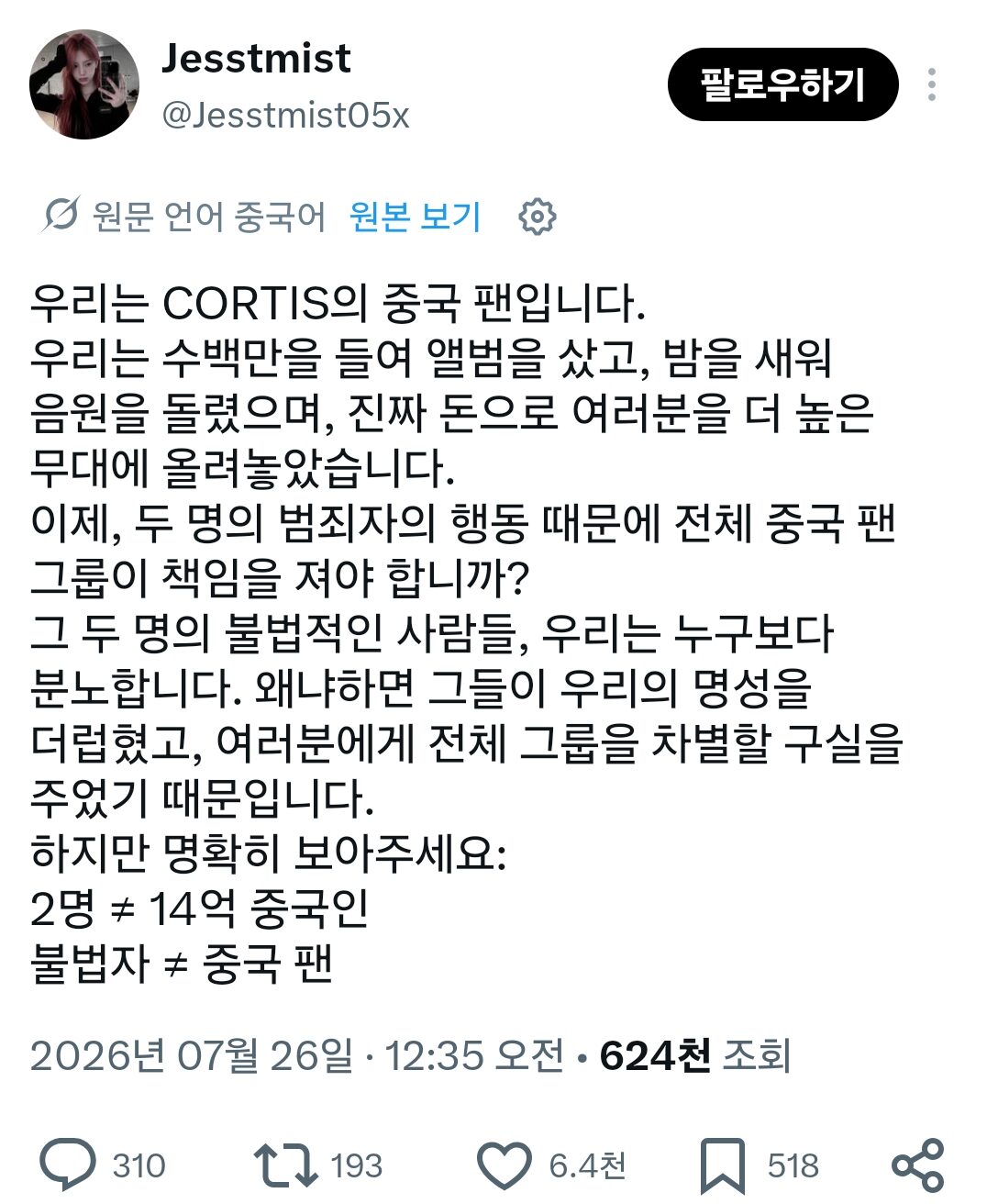
While the original intent of the statement was seemingly to distance the wider fandom from the actions of the two individuals accused of illegal activity, many Korean netizens immediately honed in on the admission. They focused particularly on the details of fans staying up all night streaming and spending considerable amounts of money, all with the goal of artificially boosting the group’s success. This revelation ignited further discussion about the integrity of music charts.
The post quickly disseminated across various Korean online communities, triggering widespread questioning about the true extent of influence that fan-driven streaming and mass album purchases have on domestic music charts. The core question became: how much of a group’s chart success is organic, and how much is engineered?
The discussion quickly broadened beyond CORTIS, with many arguing that this issue transcends a single fandom. Instead, critics claim that overseas fanbases from numerous countries have been significantly influencing Korean music charts for years, pointing to a systemic problem rather than an isolated incident.
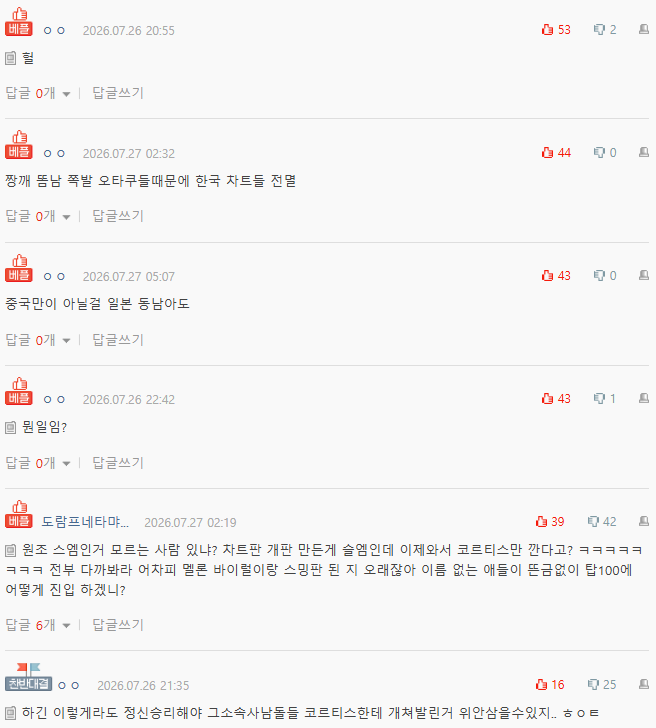
Korean netizens shared a range of reactions to the controversy. Comments included: “Whoa.” “Because of Chinese, Southeast Asian, and Japanese otakus, the Korean charts are completely ruined.” “It’s probably not just China. Japan and Southeast Asia, too.” “What happened?” “Does anyone seriously not know SM started all of this? SM was the one who turned the charts into a mess in the first place, and now people are only criticizing CORTIS? LOL. Go after everyone. Melon has been full of viral marketing and streaming manipulation for a long time. How else would unknown groups suddenly make it into the Top 100?” “Well, I guess they have to convince themselves somehow. It’s the only way fans of those male idols from that company can cope after CORTIS completely crushed them. Fighting.” The diverse opinions highlight the complex nature of fan culture, chart ethics, and industry competition.