

BTS Boycotts Grammys Over New ‘Asian Pop’ Category
The K-Pop world is buzzing after global sensation BTS announced they would not be submitting their music for the upcoming 69th Grammy Awards in February 2027. This surprising move is widely interpreted as a powerful protest against the U.S. Recording Academy’s controversial new “Best Asian Pop Music Performance” category. Fans and critics alike are questioning if this new addition truly celebrates diversity or inadvertently segregates non-Western artists.
Recording Academy Defends New Category Amid Backlash
Harvey Mason Jr., CEO of the Recording Academy, quickly issued a statement expressing his “sadness” but also “understanding and respect” for BTS’s decision. The K-pop septet, without explicitly naming the new category, voiced a strong desire for music to be “heard and loved for what it is, rather than categorized by region or language.” This sentiment deeply resonates with K-Pop fans who have long advocated for their favorite artists to be recognized purely for their artistry, not their origin.
Mason defended the new Asian Pop category, insisting it was created to celebrate the “depth, diversity, and excellence” of Asian pop art, not to “divide.” He clarified that artists can still compete in major General Field categories like Album of the Year or Song of the Year, even if they submit to genre-specific awards. The Academy’s aim, he stated, is to highlight major acts and broaden recognition among its 15,000 voting members.
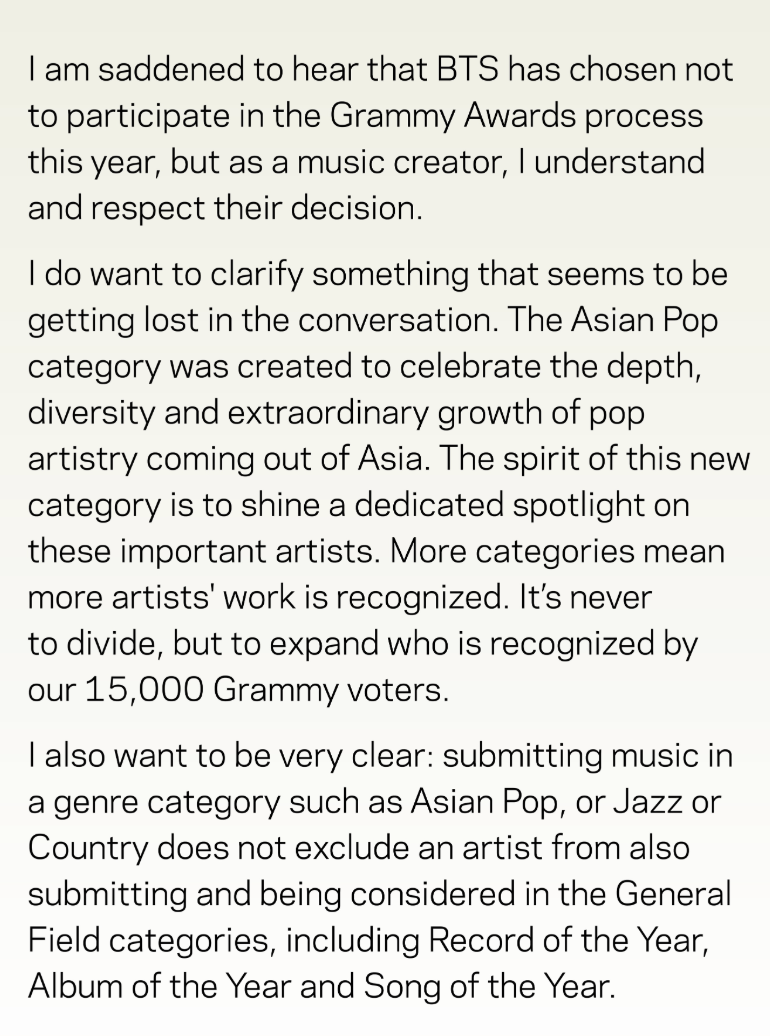
“Those categories remain open to any eligible recording, regardless of genre. Recognition in a genre category and recognition in the General Field are not mutually exclusive. An artist can absolutely pursue both,” he said, adding that the Grammys remain committed to expanding membership and listening to global voices regardless of region or language.
K-Pop’s Uphill Battle at the Grammys
This controversy highlights the Grammys’ long-standing reputation for being conservative and exclusive, particularly towards non-white artists. BTS, despite achieving massive global success – topping Billboard charts with their fifth studio album “Arirang,” released in March, and receiving multiple nominations for Best Pop Duo/Group Performance between 2021 and 2023 – has yet to secure a Grammy win. This past February, the track “Golden,” from the smash-hit soundtrack to the Netflix animated film “KPop Demon Hunters” (one of 2025’s biggest commercial hits), only took home one award for Best Song Written for Visual Media. Even Rose of BLACKPINK, whose collaboration with Bruno Mars, “APT.,” saw strong chart performance, left the ceremony empty-handed. These instances fuel the argument that K-Pop artists often face an uphill battle for mainstream recognition at the prestigious awards.
What’s Next for Global Music Recognition?
The debate surrounding the new Asian Pop category and BTS’s stance underscores a critical moment for the Grammys. Will they truly embrace global music on its own terms, or will the push for “diversity” inadvertently reinforce existing boundaries? K-Pop fans worldwide are watching closely, hoping for a future where talent is the only category that matters.